CONCLUSION
The 1971 PARC v. Pennsylvania case secured education rights for cognitively impaired children and set a lasting precedent for future court rulings and policies. It compelled the state to take responsibility for inclusive education and reinforced society’s duty to advocate for students’ rights. Today, this responsibility is upheld through laws like the Individuals with Disabilities Education Act (IDEA), ensuring education for 7.5 million students with disabilities, and through the continued efforts of advocacy groups such as The Arc and the National Disability Rights Network. The expansion of over 300 inclusive higher education programs and ongoing policy reforms demonstrate the lasting impact of the case, driving progress in disability rights and equitable education opportunities.
"New data shows that there were 7.5 million children ages 3 to 21 served under the Individuals with Disabilities Education Act during the 2022-2023 school year, accounting for 15% of all students. That’s a jump from 7.3 million the year prior and represents the highest number ever."
- Shaun Heasley, Disability Scoop Newsletter
The National Disability Rights Network advocates for 25.3 million individuals, ensuring inclusive policies and education access, n.d., National Disability Rights Network.
Influence of Federal Education
PARC v. Pennsylvania directly paved the way for laws like IDEA, securing education for 7.5 million students with disabilities and driving inclusive policies nationwide.
"P.L. 94-142 will mark its 50th anniversary in 2025. The first 35 years since the passage of this landmark law have witnessed unparalleled national progress in ensuring access to a free appropriate public education for all children with disabilities. However, continuing IDEA progress for the next 15 years will require accepting the challenge of the 1997 and 2004 amendments to IDEA to not only ensure access to education but also improve results for infants, toddlers, children, and youths with disabilities and their families in each state and every locality across the country."
- U.S. Department of Education
Michael Yudin, Assistant Secretary, Office of Special Education and Rehabilitative Services, n.d., U.S. Department of Education.
Inclusion Trends for Students with Disabilities (2012–2022)
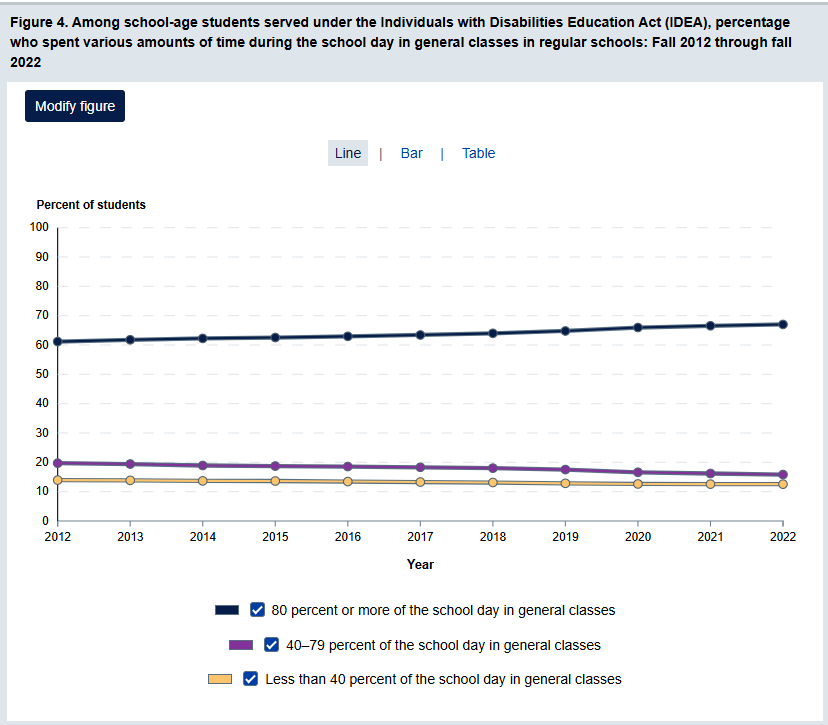
A positive trend towards greater inclusion in recent years, n.d., National Center for Education Statistics.
"We all must SEE/HEAR each child regardless of if they are verbal or nonverbal. We must see the humanity in all people, or we set up scenarios where abuse can take hold. Special education settings have been wrought with these issues for centuries. It has been the very impetus for inclusion movement."
- Dr. Charissa Reardon, Learning Support Teacher, Parkland High School, March 25, 2025